

Curriculum & Instruction

The Divisions of Curriculum are as follows:
- Elementary Education (K-6)
- Secondary Education (7-12)
- Career and Technical Education
- Field Trips
- Response to Instruction (RtI)
- Homebound Program
- Library Media Program
- Professional Development
- Textbook Adoption
Academic electives in school are important because they allow students to explore diverse interests, discover hidden talents, and learn skills that might not be covered in core subjects, ultimately fostering a well-rounded education, boosting engagement, and building confidence by letting them pursue areas they enjoy most; essentially, they provide a space for students to learn beyond the basics and develop a deeper understanding of themselves and their passions.
-
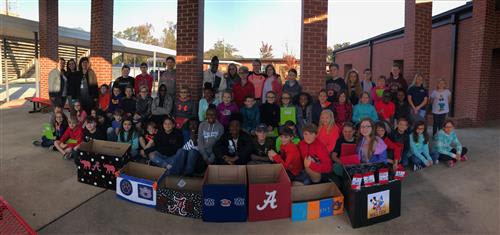
The South SSES BETA Club is part of the National Honor Society at the junior high level.
Mission Statement
The purpose of the National Beta Club shall be to promote the ideals of character, service and leadership among elementary and secondary school students, to reward meritorious achievement and to encourage and assist students in continuing their education after high school.Vision Statement
The National Beta Club, a student-centered organization, continually develops and nurtures individuals by providing opportunities and experiences enabling them to demonstrate the ideals of character, achievement, service and leadership in a global community.The National Beta Club® and the The National Beta Club logo are registered trademarks and service marks of The National Beta Club Clubs International. Used by permission.
-
Fine Arts
Fine arts education is important in schools because it helps students develop creativity, critical thinking, and problem-solving skills. It also helps students build self-confidence and resilience.
Benefits of fine arts education
- Communication: Students learn to communicate their ideas and understand how to communicate with others
- Perspective: Students learn to see the world in new ways and develop new perspectives
- Social skills: Students learn to connect with others, understand diversity, and build empathy
- Self-direction: Students learn to become self-directed learners who seek to extend their knowledge
- Life skills: Students develop skills that are useful in their personal and professional lives
- Community: Students build a sense of community with other creative individuals
Other benefits of fine arts education
- Improves school engagement and culture
- Strengthens community and civic engagement
- Supports social and emotional development
- Helps students develop motor skills and language skills
- Teaches students about color, layout, perspective, and balance.
-
GIFTED EDUCATION
The Lee County Board of Education offers a gifted program that ensures services to all students at each grade level cluster are of comparable quality and duration; and provides a differentiated program in content, process and product. Referrals will be accepted for grades K-6. Lee County Schools conducts Child Find activities for all 2nd grade students in the system to determine eligibility for the gifted program.
Gifted students are those who perform, or who have demonstrated the potential to perform, at high levels in academic or creative fields when compared to others of their age, experience, or environment. These students require services not ordinarily provided by the regular school program. Students possessing these abilities can be found in all populations, across all economic strata, and in all areas of human endeavor.
A student may be referred for consideration for gifted services by teachers, counselors, administrators, parents or guardians, peer, self, or any other individuals with knowledge of the student’s abilities. Lee County Schools screen all referrals to determine if formal and informal assessments should be administered to continue the decision making process concerning eligibility. Students referred for the gifted program who do not meet the screening criteria will not continue the eligibility process. In addition, all second grade students will be observed as potential gifted referrals using a gifted behavior check list.
For each student referred, information is gathered in the following three areas:
The scores from the assessments/items used are entered on a matrix where points are assigned according to established criteria. The total number of points earned determines if the student qualifies for gifted services.
A variety of service delivery options are available for gifted students throughout Lee County such as: resource room pull-out programs, content area classes, seminars, independent study, dual enrollment, cluster grouping, and curriculum compacting.
Because gifted learners have abilities and needs different from typical learners, gifted program offerings differ from typical education in content, process, product and learning environment
If you have any questions or would like to obtain additional information regarding the gifted program, contact the gifted program director at 334-705-6000.
- Aptitude – Aptitude should be assessed through individual or group test of intelligence or creativity
- Characteristics – A behavior rating scale designed to assess gifted behaviors is completed by a classroom teacher.
- Performance – At least three indicators of performance at a gifted level must be submitted. These may include, but are not limited to, achievement test scores, grades, products, work samples, and/or portfolios.
-
The K-4 music curriculum is designed to provide joyful experiences for the children, while helping them to develop skills and intellectual processes that will not only provide for success in the music classroom, but will also carry over into other academic and nonacademic areas. The K-4 music curriculum provides for creativity and spontaneity as well as structure. The study of the elements of elementary general music - rhythm, melody/pitch, expression, timbre - and the process of learning music skills allow for creative expression in a wide variety of styles.
-
Lee County Students enjoy participating in STEM activities!
STEM is an acronym for science, technology, engineering, and mathematics. It's used to describe a field of study, a curriculum, or a group of related technical disciplines.
STEM in education
- STEM education encourages students to explore, experiment, and solve real-world problems.
- STEM literacy can lead to higher-earning jobs in a knowledge-based economy.
- STEM graduates are in high demand, and many colleges and the U.S. government are encouraging students to study STEM.
- STEM programs include computer science, engineering, mathematics, and the natural, physical, and life sciences.
There are no resources to display
Students are engaged in hands-on learning activities during their STEM LAB time twice a month.
Mrs. Baldwin STEM Resource Teacher